Easter in Zakynthos, an interview with Christina Tetradis
Christina Tetradis, President of Lagana Hoteliers Association, speaks to Taksidi 2 Greece, about Easter in Zakynthos Island

Easter in Zakynthos: The outstanding the visitor will live there
Holy Week in Zakynthos has a very own unique colour. It also has a separate standard in the religious rituals and its own ancient traditions, which the inhabitants respect and comply with unique care and devotion. Some of these events have been influenced by the long presence of western Europeans on the island (mostly from the Venetian) and others are attributed to blessed Bishop of the island, Dionysius Lata, who lived in Jerusalem and brought, according to sayings, many of the traditions of the Holy City to the strongly scented island of the Ionian Sea.
Holy Week actually begins on Saturday of Lazarus, when at 11 am the church bells ring solemnly and the “vagi” is being hang on all the steeples of the city and villages of our island. At the Cathedral of St. Nicholas of Visitors the hanging of the “vagi” is held with special grandeur, at 12 o’clock noon on the same day. This custom was transferred at the Cathedral after the earthquake of 1953 when the Church of All Saints was, unfortunately, demolished. The “vagi” in Zakynthos is not well-known bay leaf, shared at the rest of Greece that same day, but fresh yellowish leaves of palm stranded into crosses, sunflowers, horses and even women bringing “vagia”, in order to decorate the churches for the celebration.
On Palm Sunday, after the Divine Liturgy, held on churches decorated with “vagia”, «nontsoloi” distribute the “vagi” to every home, as the blessing of the Priest and believers place them among the sacred images. After the end of the Divine Liturgy, the temples are decorated in a mourning way. The black colour is everywhere. Covers, «capitola», vestments, sacred vessels, all in black. In the evening, the sequence of the Prince of Peace is performed. At the evening of Holy Tuesday, you are going to hear the Hymn of Kassiani (Doxastikon of Apostichon), chanted from the melodic choruses of our churches and especially the Holy Monastery of Strofades and St. Dionysios, the Metropolitan Church of Agios Nikolaos and Church of Faneromeni in the city.
On Holy Thursday morning Divine Liturgy is performed in all churches. Afterwards, the bells of Zakynthos don’t ring again, not until the morning of Holy Saturday.
«They are becoming widows” according to a good Zakynthian expression. But not only bells become widows, everything mourn. Black flags are hanging on the balconies of the houses, at half-mast, even the clothing, especially of the older of Zakynthos is mournful.
The specificities of Zakynthian ecclesiastical standard are becoming stronger after the Holy Thursday evening. First of all, you will be surprised by listening to the hymns «Diamerisanto ta imatia moy eaftis..» and «Exigorasas imas ek tis kataras too nomou…” hich are accented by the Zakynthian church music.
One will in vain wait to see the Crucified coming out of the Church after the fifth gospel, as perhaps he will have been used to so far in his own region. But on our island, the Crucified comes out after the eleventh gospel. The cantor in front of the Crucified chants according to the Zakynthian State anthem «Simeron kremate epi xilou…» and immediately after the choir or chanters sing the famous psalm «Ina ti efriaxan ethni..» -only in Zakynthos- in a meditating atmosphere, while the Crucified is being carried in litany. The twelfth Gospel «Ti epavrion…» chanted in the Zakynthian way is certainly the culmination of the sequence of Great Thursday.
On Holy Friday the island is in great excitement. Everything in Zakynthos, of reasonable or not nature, is involved in the Divine Drama.
At morning the Service of Holy Hours is performed and subsequently, the deposition from the cross, who in Zakynthos is performed at the same time when the Verses «Ote ek tou xilou Se nekron….» are sung.
After a while the priest leaves the sanctuary carrying Christ - wrapped with a white sheet - on his shoulder in litany. Note that in Zakynthos the embroidered Epitaph, which is known to the rest of Greece, is not used. In its place a wooden carved hagiography (religious painting) of the dead Christ, which is called «Amnos» (lamb) is used. After the litany the body of Christ is placed on the Epitaph, which will impress you because the specificity of Zakynthos is obvious once more. In Zakynthos, the Epitaphs are not decorated with flowers because they are carved in wood with layers of gold and velvet, real artworks.
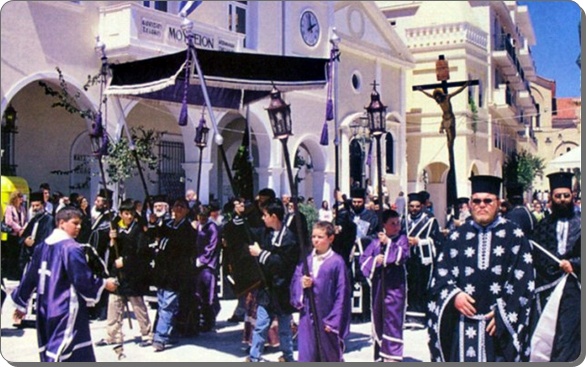
Holy Friday afternoon. Time 14.00. The culmination of the Zakynthian Holy Week. The world, Zakynthos and visitors flock to the Church of St. Nicholas of Molos, in Solomou square, where the start of the –unique in Orthodoxy- litany of the Crucified takes place. The Bishop, priests, the deacons are dressed in their black vestments and the world is waiting anxiously for the removal of the Crucified from the church. The atmosphere is unique.
The excitement permeates every Zakynthian soul. The mournful litany begins to the strains of «Ina ti efriaxan ethni…» from the Philharmonic. Along with the Crucified, under the black «Urania», the famous image of «Mater Delorosa», ie the Virgin of the Passion, comes out in litany too. The procession crosses almost the entire city and returns to the Solomou Square, where, on a pedestal, the Bishop blesses the clergy and the people with the Crucified, making a cross in the four cardinal points, by the sounds of “Kai klinas tin kefalin”. The procession ends at the same church, where the deposition of Christ in the Epitaph is performed.
On Holy Friday, at night, the service of the Epitaphs’ Mourning is performed in all the churches. But in Zakynthos this happens without the litany of the Epitaphs. At the St Nicholas Cathedral of the Visitors, according to an old local custom, this litany does not take place on the night of Holy Friday, but in the early hours of the Holy Saturday, and particularly at 2:00 in the morning. At 4:00 in the morning the gilded carved Epitaph is carried out of the church, while thousands of people watch these unique moments. During the years of the Venetian Rule, on the island animal slaughter was strictly prohibited before the Holy Saturday
With the ringing of the bell, in the First Resurrection, the first butcher who would slaughter the animal quickly and present all or «piece» of it at the ruler of the island, won a prize. From this fact, the First Resurrection took after the name «piece».
The Epitaph returns at the Church at about 5:30 where the service is carried on, and the nicest hymn «Ton Kirio Imnite…», along with the famous «Gloria» are sang and followed by the breaking of clay jugs at St. Mark’s Square. “Gloria” means glory. The name comes out from the effect of Catholics, who used to celebrate Easter by singing “Gloria in exelsis Deo”.
On the night of the Holy Saturday, at 11.15, the Sequence begins at the Cathedral, meanwhile, has completely changed in appearance, having dressed in red. At 11.45, the procession towards St. Mark’s Square begins, because there happens the Resurrection. «Christ has risen» comes out the lips of the Bishop, this also in the peculiar way of the zakynthian church music, offers to all Christians, coming to the square and the surrounding areas, the message of the Resurrection of Christ, while immediately after the image of the Resurrection, always accompanied by the priests and the Philharmonic, returns to the Cathedral, where the «Arate Pylas” begin. According to the local tradition, the Divine Liturgy of the Resurrection is not performed immediately after in any church of the town or villages, but the morning of the Easter Sunday. According to the «anteti», during the reading of the Gospel, the bells of the churches should be ringing. Note that only at the Church of Our Patron Saint Dionysius, the Divine Liturgy of the Resurrection is held twice, firstly at 1:00 am and the second at the morning of Easter Sunday.
In the afternoon of Easter Sunday the Vespers of Love takes place at the Church of St. Lazarus of the city and the procession of the majestic image of Panagia Galanousa, along with the image of the Resurrection.
On Easter Monday, most villages celebrate. Combine a small excursion to visit them, to visit the beautiful temples and watch the Easter processions and functions (morning and afternoon) of the venerable images of the Virgin Mary and the Resurrection. In our city, this afternoon, the procession is the image of Our Lady Panagia Laourentaina from Psiloma (Bohali) to the Church of the Holy Trinity, takes place.
On Friday Easter the picturesque suburb of Bohali celebrates. There shall be, within the magnificent spring, the traditional festival with procession of ancient and miraculous image of Panagia of Chrysopigi, by the sounds of «tampourloniakaro”.
The celebration of Easter ends up on Sunday after Easter (Sunday of Thomas) with the traditional folk festival in the picturesque chapel of St. Lypios in the area Kallitero (1 km away from the city).
Easter culinary tradition
In Zakynthos, there are many traditions around Easter and the Easter table, or Holy Week. Some of the traditional recipes that are made during the Holy Week and Easter here are these:
On Holy Monday, they make the cookies.
On Holy Wednesday, they prepare yeast to make Lamprokouloures.
On Holy Thursday, they dye eggs and make up artichokes stuffed with rice or peas with potatoes, artichokes and green beans.
On Holy Friday, they eat kneaded bread, lettuce and dried beans, boiled artichokes without oil. On this day, they not pave tablecloth on the table because of mourning…
On Holy Saturday, they prepare food for the Easter table, which is sgatzeto and skotaria, intestines of lamb that is, cooked in a particular way. Besides sgatzeto, the Easter table does not lack of red eggs, ham (kind of sausage made at the time), fresh local cheese “Ladotyri”, “Prentza” (type of cheese like feta), gardouba, lettuce salad with spring onions, rocket and red wine.
Beef stew and Zakynthian Lamprokouloura.
On the day of Easter, the Zakynthians did not used to eat spit-roasted lamb. This is outlandish custom. They ate beef with egg and lemon sauce and rice with leeks. This was presumably because after the great fast of Lent, the stomach was not prepared for a heavy meal such as lamb. But this custom goes out nowadays and most people roast lamb or goat on the spit.
On Easter Monday the Zakynthians used to cook lamb in the oven, which came with the red eggs, local Ladotyri, Prentzas, ham and local red wine.
Η Χριστίνα Τετράδη, πρόεδρος των ξενοδόχων Λαγανα Ζακύνθου μας μιλά για το Πάσχα στη Ζάκυνθο

Πάσχα στη Ζάκυνθο: Τι ξεχωριστό θα ζήσει εκεί ο επισκέπτης
Η Μεγάλη Εβδομάδα στη Ζάκυνθο, έχει ένα δικό της εντελώς χαρακτηριστικό χρώμα. Έχει επίσης ξεχωριστό τυπικό στις θρησκευτικές της τελετές και δικά της πανάρχαια έθιμα, που οι κάτοικοι της τα σέβονται και τα τηρούν με μοναδική φροντίδα και ευλάβεια. Μερικές από τις εκδηλώσεις αυτές έχουν επηρεαστεί από τη μακρόχρονη παρουσία των Δυτικών στο νησί (κυρίως από τη Βενετοκρατία) και άλλα αποδίδονται στο μακαριστό Μητροπολίτη του νησιού, Διονύσιο Λάτα, που έζησε στα Ιεροσόλυμα και έφερε, όπως λέγεται πολλά από τα έθιμα της Αγίας Πόλης στο μυρωμένο νησί του Ιονίου.
Το Μεγαλοβδόμαδο αρχίζει ουσιαστικά το Σάββατο του Λαζάρου, όταν στις 11 το πρωί οι καμπάνες των εκκλησιών χτυπούν πανηγυρικά και κρεμιέται το «βαγί» σ’ όλα τα καμπαναριά της πόλης και χωριών του νησιού μας. Ιδιαίτερη μεγαλοπρέπεια έχει το «κρέμασμα του «βαγιού» στο Μητροπολιτικό Ναό του Αγίου Νικολάου των Ξένων, που γίνεται στις 12 ακριβώς το μεσημέρι της ίδιας ημέρας. Το έθιμο αυτό μεταφέρθηκε μετά το σεισμό του 1953 στη Μητρόπολη από την εκκλησία των Αγίων Πάντων, που, δυστυχώς, γκρεμίστηκε. Το βαγί στη Ζάκυνθο δεν είναι η γνωστή δάφνη, που μοιράζεται στην υπόλοιπη Ελλάδα αυτή τη μέρα, αλλά τα φρέσκα κιτρινωπά φύλλα του φοίνικα, που μ’ αυτά πλέκουν σταυρούς, «βαγιοφόρες», ήλιους, αλογάκια κ.ά. και στολίζουν τις εκκλησίες για τη γιορτή.
Την Κυριακή των Βαΐων, μετά τη θεία Λειτουργία, στις στολισμένες με βαγιά εκκλησίες, οι «νόντσολοι», μοιράζουν σ’ όλα τα σπίτια το βαγί ως ευλογία του Ιερέως - Εφημερίου και οι πιστοί το τοποθετούν στις εικόνες. Μετά το τέλος της Λειτουργίας, οι ναοί μας ντύνονται στα πένθιμα. Τα μαύρα «πευκιά» κυριαρχούν παντού. Καλύμματα, «καπίτολα», άμφια, ιερά σκεύη, όλα στα μαύρα. Το βράδυ τελείται η Ακολουθία του Νυμφίου.
Τη Μεγάλη Τρίτη το βράδυ θα ακούσετε το κατανυκτικότατο τροπάριο της Κασσιανής (Δοξαστικό των Αποστίχων), όπως ψάλλεται από τις μελωδικές χορωδίες των ναών μας και ιδιαιτέρως της Ι. Μονής Στροφάδων και Αγίου Διονυσίου, του Μητροπολιτικού Ναού Αγίου Νικολάου και της Φανερωμένης στην πόλη.
Τη Μεγάλη Πέμπτη το πρωί γίνεται ο Εσπερινός και η θεία Λειτουργία σ’ όλους τους Ναούς. Μετά απ’ αυτήν, οι καμπάνες της Ζακύνθου δεν ξανακτυπούν, μέχρι το πρωί του Μεγάλου Σαββάτου. «Χηρεύουν», κατά την ωραία ζακυνθινή έκφραση. Αλλά δεν χηρεύουν μόνο οι καμπάνες, πενθούν τα πάντα. Μαύρα Λάβαρα κρεμιούνται στα μπαλκόνια των σπιτιών, οι σημαίες είναι μεσίστιες, ακόμη και η ενδυμασία, ιδιαίτερα των μεγαλύτερων σε ηλικία Ζακυνθινών, είναι πένθιμη.
Οι ιδιομορφίες του Ζακυνθινού εκκλησιαστικού τυπικού είναι εντονότερες από τη Μεγάλη Πέμπτη το βράδυ. Πρώτα απ’ όλα, θα σας ξαφνιάσει το άκουσμα των ύμνων «Διεμερίσαντο τα ιμάτιά μου εαυτοίς…» και το «Εξηγόρασας ημάς εκ της κατάρας τον Νόμου…», που είναι τονισμένα κατά τη ζακυνθινή εκκλησιαστική μουσική.
Άδικα θα περιμένετε να δείτε τον Εσταυρωμένο να εξέρχεται μετά το πέμπτο Ευαγγέλιο, όπως ίσως μέχρι τώρα έχετε συνηθίσει στην πατρίδα σας. Στο νησί μας, ο Εσταυρωμένος βγαίνει μετά το ενδέκατο Ευαγγέλιο. Ο ψάλτης μπροστά στον Εσταυρωμένο ψάλλει, κατά το ζακυνθινό μέλος, τον ύμνο «Σήμερον κρεμάται επί ξύλου…», ενώ αμέσως μετά ψάλλετε από τη χορωδία ή τους ψάλτες (μόνο στη Ζάκυνθο) ο περίφημος Ψαλμός «Ινα τι εφρύαξαν έθνη…», μέσα σε κατανυκτική ατμόσφαιρα, ενώ λιτανεύεται ο Εσταυρωμένος. Το δωδέκατο Ευαγγέλιο «Τη επαύριον…», ψαλλόμενο κι αυτό οπωσδήποτε στα «ζακυνθινά», αποτελεί το αποκορύφωμα της Ακολουθίας της Μεγάλης Πέμπτης.
Η Μεγάλη Παρασκευή βρίσκει το νησί μας σε φοβερή υπερένταση. Τα πάντα στη Ζάκυνθο, η λογική και η άλογος φύση, συμμετέχουν στο θείο Δράμα.
Το πρωί γίνεται η Ακολουθία των Μεγάλων Ωρών και, ακολούθως, η Αποκαθήλωση, που στη Ζάκυνθο τελείται κατά τη στιγμή που ψάλλονται τα Απόστιχα «Οτε εκ του ξύλου Σε νεκρόν…». Μετά από λίγο, ο Ιερεύς θα εξέλθει από το Ιερό Βήμα λιτανεύοντας τον Χριστό επί του ώμου του, τυλιγμένο σε λευκό σεντόνι. Σημειωτέον ότι στη Ζάκυνθο δεν χρησιμοποιείται ο γνωστός στην υπόλοιπη Ελλάδα κεντητός Επιτάφιος, αλλά αμφιπρόσωπη ξυλόγλυπτη αγιογραφία του νεκρού Χριστού, που ονομάζεται «Αμνός». Μετά τη λιτάνευση, το Σώμα του Χριστού τοποθετείται στον Επιτάφιο, που σίγουρα θα σας εντυπωσιάσει, αφού και πάλι εδώ η ιδιαιτερότητα της Ζακύνθου είναι εμφανής. Εδώ οι επιτάφιοι δεν στολίζονται με λουλούδια, επειδή είναι ξυλόγλυπτοι, με επένδυση φύλλου χρυσού και βελούδου, δηλαδή πραγματικά έργα τέχνης.
Mεγάλη Παρασκευή μεσημέρι. Ώρα 2.00. Το αποκορύφωμα του Ζακυνθινού Μεγαλοβδόμαδου. Ο κόσμος, Ζακυνθινοί και επισκέπτες, συρρέουν στον Ιερό Ναό του Αγίου Νικολάου του Μώλου, στην πλατεία Σολωμού, απ’ όπου θα ξεκινήσει η -μοναδική στην Ορθοδοξία- λιτανεία του Εσταυρωμένου. Ο Μητροπολίτης, οι Ιερείς, οι Διάκονοι είναι ντυμένοι στα μαύρα τους άμφια και ο κόσμος αναμένει με αγωνία την έξοδο του Εσταυρωμένου από το ναό. Η ατμόσφαιρα είναι μοναδική.
Η συγκίνηση διαπερνά κάθε ζακυνθινή ψυχή. Η πένθιμη και κατανυκτική λιτανεία, αρχίζει υπό τους ήχους του «Ινα τι εφρύαξαν έθνη…» από τη Φιλαρμονική. Μαζί με τον Εσταυρωμένο λιτανεύεται, κάτω από τη μαύρη «Ουρανία», και η περίφημη Εικόνα της «Mater Delorosa», δηλαδή της Παναγίας του Πάθους. Η λιτανεία διασχίζει σχεδόν όλη την πόλη και επιστρέφει στην πλατεία Σολωμού, όπου, πάνω σε βάθρο, ο Μητροπολίτης ευλογεί τον κλήρο και το λαό με τον Εσταυρωμένο, κάνοντας το σημείο του σταυρού στα τέσσερα σημεία του ορίζοντα, υπό τους ήχους του «Και κλίνας την κεφαλήν». Η λιτανεία καταλήγει στον ίδιο ναό, όπου γίνεται η εναπόθεση του Χριστού στον Επιτάφιο.
Το βράδυ της Μεγάλης Παρασκευής γίνεται κανονικά σ’ όλους τους Ιερούς Ναούς η Ακολουθία του Επιτάφιου Θρήνου. Στην πόλη όμως, δεν γίνεται λιτάνευση των Επιταφίων τους. Στον Μητροπολιτικό Ναό του Αγίου Νικολάου των Ξένων η Ακολουθία αυτή, σύμφωνα με παμπάλαιο τοπικό έθιμο, δε γίνεται το βράδυ της Μεγάλης Παρασκευής, αλλά τις πρώτες πρωινές ώρες του Μεγάλου Σαββάτου και συγκεκριμένα στις 2.00 το πρωί. Στις 4.00 περίπου το πρωί γίνεται η έξοδος του χρυσωμένου και ξυλόγλυπτου Επιταφίου, ενώ χιλιάδες κόσμου παρακολουθούν τις μοναδικές αυτές στιγμές. Κατά τα χρόνια της Βενετοκρατίας στη Ζάκυνθο απαγορευόταν αυστηρά η σφαγή ζώων προ του Μεγάλου Σαββάτου. Με το κτύπημα των κωδώνων, στην Πρώτη Ανάσταση, εκείνος από τους κρεοπώλες που θα έσφαζε γρηγορότερα το ζώο και θα το προσκόμιζε ολόκληρο ή «κομμάτι» του στον τότε άρχοντα του νησιού, έπαιρνε κάποιο βραβείο. Από αυτό το γεγονός, έλαβε η Πρώτη Ανάσταση την ονομασία «κομμάτι».
Ο επιτάφιος επιστρέφει γύρω στις 5.30 στο Ναό όπου συνεχίζεται η ακολουθία, και ψάλλεται ο ύμνος «Τον Κύριον υμνείτε…» και η ξακουστή «Gloria” που ακολουθούνται από το σπάσιμο των πήλινων σταμνών στην Πλατεία Αγίου Μάρκου. Gloria (Γκλόρια) σημαίνει δόξα. Η ονομασία προέρχεται από επίδραση των Ρωμαιοκαθολικών, οι οποίοι γιόρταζαν το Πάσχα με το Gloria in exelsis Deo – Δόξα εν υψίστοις Θεώ.
Τη νύχτα του Μεγάλου Σαββάτου, στις 11.15, αρχίζει η Ακολουθία στο Μητροπολιτικό Ναό, που, εν τω μεταξύ, έχει αλλάξει τελείως όψη, έχοντας ντυθεί στα κόκκινα. Στις 11.45 ξεκινά η Αναστάσιμη πομπή για την πλατεία Αγίου Μάρκου, όπου γίνεται η Ανάσταση. Το «Χριστός Ανέστη», από τα χείλη του Μητροπολίτη, ψαλλόμενο κι αυτό κατά την ιδιόμορφη ζακυνθινή εκκλησιαστική μουσική, μεταδίδει σ’ όλους τους χριστιανούς, που κατακλύζουν την πλατεία και τους γύρω χώρους, το μήνυμα της Αναστάσεως του Χριστού, ενώ αμέσως μετά η Εικόνα της Ανάστασης, με τη συνοδεία πάντοτε των Ιερέων και της Φιλαρμονικής, επιστρέφει στο Μητροπολιτικό Ναό, όπου διαδραματίζονται τα του «Αρατε Πύλας… «. Κατά την τοπική παράδοση, η Αναστάσιμη θεία Λειτουργία δεν τελείται αμέσως μετά σε κανένα ναό της πόλεως και των χωριών, αλλά το πρωί της Κυριακής του Πάσχα. Το «αντέτι» θέλει, κατά τη διάρκεια της αναγνώσεως του Ευαγγελίου, να κτυπούν οι καμπάνες των εκκλησιών. Ας σημειωθεί ότι μόνο στο Ναό του Πολιούχου μας Αγίου Διονυσίου πραγματοποιούνται δύο Αναστάσιμες Θείες Λειτουργίες. Η πρώτη στη 1.00 π.μ. (μεταμεσονύκτιο) και η δεύτερη το πρωί της Κυριακής του Πάσχα.
Το απόγευμα της Κυριακής του Πάσχα γίνεται ο Εσπερινός της Αγάπης στον Ιερό Ναό του Αγίου Λαζάρου της πόλεως και λιτάνευση της επιβλητικής εικόνας της Παναγίας της Γαλανούσας, καθώς και της εικόνας της Αναστάσεως.
Τη Δευτέρα του Πάσχα τα περισσότερα χωριά μας πανηγυρίζουν. Συνδυάστε μια μικρή εκδρομή σ’ αυτά, επισκεφθείτε τους ωραιότατους ναούς και παρακολουθείστε τις Αναστάσιμες Λειτουργίες και λιτανείες (πρωί και απόγευμα) των σεπτών εικόνων της Παναγίας και της Αναστάσεως. Στην πόλη μας, το απόγευμα, γίνεται η λιτάνευση της εικόνας της Παναγίας της Λαουρένταινας, από το Ψήλωμα (Μπόχαλη) προς τον Ιερό Ναό της Αγίας Τριάδος.
Την Παρασκευή της Διακαινησίμου γιορτάζει το γραφικότατο προάστιο της Μπόχαλης. Εκεί πραγματοποιείται, μέσα στη μαγευτική ανοιξιάτικη φύση, το παραδοσιακό πανηγύρι με λιτάνευση της πανάρχαιας και θαυματουργού εικόνας της Παναγίας της Χρυσοπηγής, υπό τους ήχους του «ταμπουρλονιάκαρου» .
Οι εορταστικές εκδηλώσεις του Πάσχα κλείνουν την Κυριακή του Θωμά με το παραδοσιακό λαϊκό πανηγύρι στο γραφικό εξωκλήσι του Αγίου Λύπιου, στην περιοχή Καλλίτερο (1 χλμ. από την πόλη).
Πασχαλινή γαστρονομική παράδοση
Στη Ζάκυνθο υπάρχουν πολλά έθιμα γύρω από το Πάσχα και το πασχαλινό τραπέζι ή τη Μεγάλη Εβδομάδα. Μερικές από τις παραδοσιακές συνταγές που κάνουν τη Μεγάλη Εβδομάδα και το Πάσχα εδώ, είναι οι εξής:
Μεγάλη Δευτέρα, φτιάχνουν τα κουλούρια.
Μεγάλη Τετάρτη, αναπιάνουν προζύμι για να φτιάξουν Λαμπροκουλούρες.
Μεγάλη Πέμπτη βάφουν αυγά και φτιάχνουν αγκινάρες παραγεμιστές με ρύζι, ή αρακά με πατάτες, αγκινάρες με χλωρά κουκιά.
Μεγάλη Παρασκευή τρώνε εφτάζυμα ψωμιά, μαρούλια και νερόβραστα ξερά κουκιά, αγκινάρες βραστές. Τη μέρα αυτή, δεν στρώνουν τραπεζομάντηλο στο τραπέζι λόγω πένθους…
Το Μεγάλο Σάββατο, προετοιμάζουν το φαγητό για το αναστάσιμο τραπέζι, που είναι το σγατζέτο και η σκωταριά, τα εντόσθια του αρνιού δηλαδή, μαγειρεμένα με συγκεκριμένο τρόπο. Εκτός από το σγατζέτο, από το αναστάσιμο τραπέζι δεν λείπουν τα κόκκινα αυγά, το χοιρομέρι (είδος ντόπιου αλλαντικού που φτιάχνεται τότε), φρέσκο ντόπιο λαδοτύρι, πρέντζα (είδος τυριού σαν φέτα), γαρδούμπες, μαρουλοσαλάτα με φρέσκα κρεμμυδάκια, ρόκα και κόκκινο κρασί.
Μοσχάρι βραστό και η ζακυνθινή Λαμπροκουλούρα.
Ανήμερα του Πάσχα, οι ζακυνθινοί δεν έτρωγαν αρνί στη σούβλα. Αυτό είναι ξενόφερτο έθιμο. Έτρωγαν βοδινό κρέας αυγολέμονο και ρύζι με πράσα. Αυτό γινόταν υποθέτω, επειδή μετά από τη μεγάλη νηστεία της σαρακοστής, το στομάχι δεν ήταν προετοιμασμένο για ένα βαρύ φαγητό, όπως το αρνί. Αυτό το έθιμο σβήνει και ο περισσότερος κόσμος ψήνει αρνί ή κατσίκι στη σούβλα.
Τη Δευτέρα του Πάσχα οι ζακυνθινοί φούρνιζαν αρνί, Αρνί ψημένο πάνω σε κληματόβεργες στο φούρνο, το οποίο το συνόδευαν με κόκκινα αυγά, λαδοτύρι ντόπιο, πρέντζα, χοιρομέρι και ντόπιο κόκκινο κρασί.
Photos: http://www.zanteparkhotels.travel/pages/show_page/10